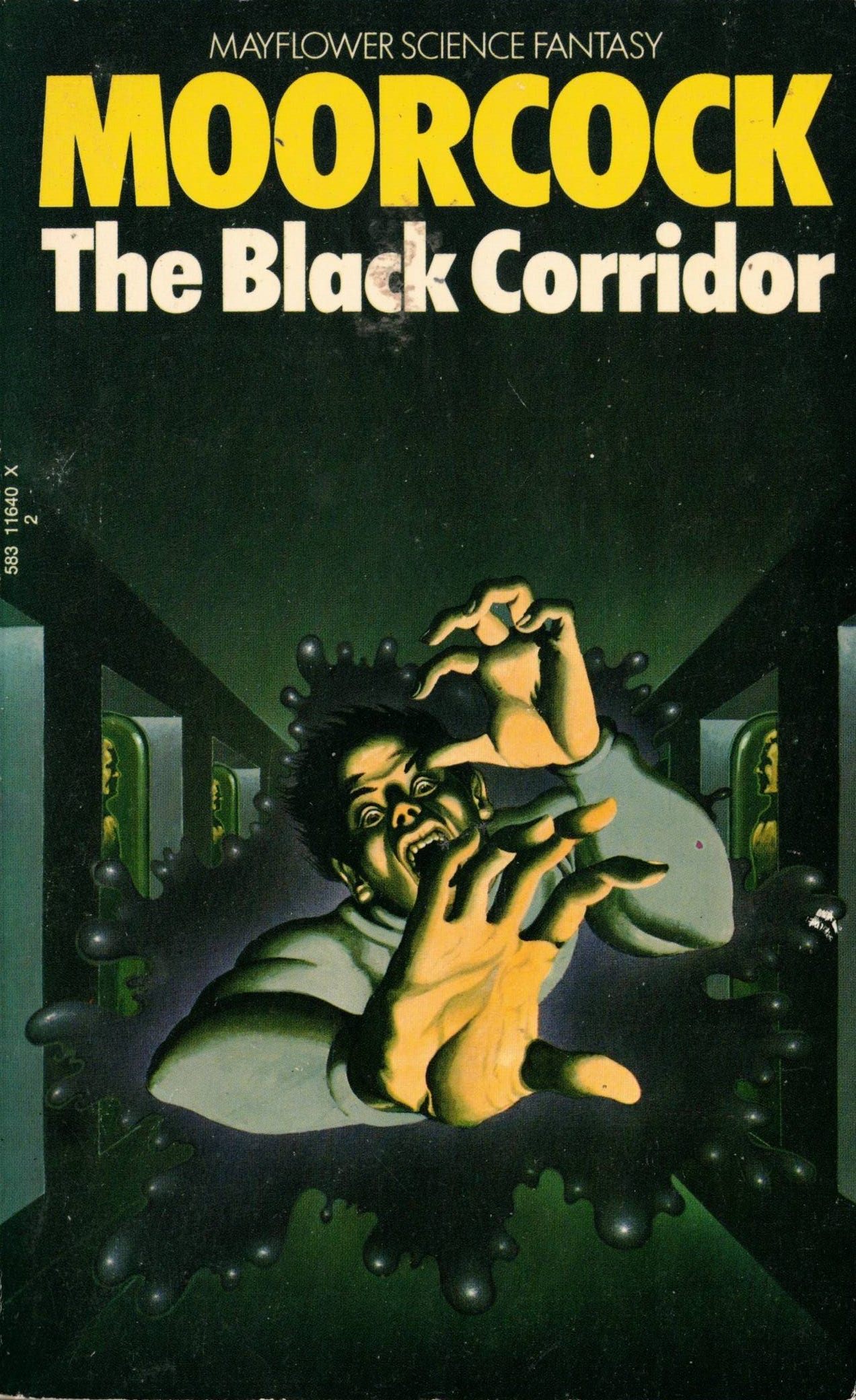
Cover of the Week: The Black Corridor by Michael Moorcock

Mayflower 563 11640 X (1973)

It’s a shame that this British Mayflower paperback doesn’t list the cover artist because he/she deserves to be credited for creating this dramatic, surrealist cover that fits Michael Moorcock’s story perfectly. Mayflower reprinted many of Moorcock’s books in paperback, including several of his most popular books, like Stormbringer, Behold the Man (a fantastic book), and The Final Programme. Mayflower states that the book is “Science Fantasy,” which I think describes Moorcock’s work very well, although he leans toward the grimdark style of writing that is directly opposite of Tolkien’s “high fantasy” (he hated Tolkien’s work, by the way).

From the blurb on the back of the book (which deserves to be quoted for its over-the-top style:

The world is sick. The Forces of Chaos have energized the planet. Leaders, fuhrers, duces, prophets, visionaries, gurus, and politicians are all at each other’s throats. And Chaos leers over the broken body of the Order.

So Ryan freezes his family into suspended animation and sets off for the planet Munich 15040, five years distant. There he will re-establish Order in a New World - and create a happier, healthier, saner, and more decent society with the ones he loves.

But they are suspended. And they cannot talk. And he is alone in space. And he has been traveling for three years. And he will still be traveling two years hence, and he cannot see his destination, and is ALONE and LOST and CRACKING UP…


Comments

Popular posts from this blog

Welcome

Thank you for visiting my website. You'll find information about me and my activities/social media here. If you came here looking for the actor Richard Grove , you've found him. For some crazy reason, I chose to use Richard as my first name while working as an actor in Hollywood. I have a separate post devoted to Richard Grove's acting career.  At present, I am producing a podcast about paperbacks called " The Paperback Show " and participating in a podcast about machinima (3D movies made within video games) called " And Now For Something Completely Machinima ".  I am also an online bookseller  on  eBay  and Etsy under the name " Grove Used Books " . In addition to books, I also sell collectibles, DVDs, and comic books.  Lastly, I have social media pages on Instagram and Facebook . My Flickr page contains all of my found photographs and photos I've taken over the years.  You'll find more detailed info on each of these activities in se...

Sloven Genius: Auden by Peter Ackroyd

  I came to  Wystan Hugh Auden  by way of Tolkien. I devoured the notes and bibliography section of Tolkien’s biography written by Humphrey Carpenter. Auden is mentioned as being an early supporter of Tolkien’s trilogy and wrote influential reviews of the first two books in the trilogy. So I searched for Auden in the bookstore where I was working and found his first collection of essays, reviews, and aphorisms,  The Dyer’s Hand  (1967) .  Many of the essays were revelations to me, ( Making, Knowing and Judging ) others I simply didn’t understand because I was too young. Auden’s essays led me to his poetry which I found challenging as well (I was 17 at the time), but I was also impressed. They captured my imagination in a way no other poet did and they inspired me to explore the words he used and research the subjects he wrote about. His writing enriched my life. Thus began a life-long interest in Auden. I’ve been reading his work for most of my life. I stil...

Philip Roth and the "Writers From the Other Europe" Series

Philip Roth’s  Writers from the Other Europe  was a Penguin paperback series he launched and served as general editor for, beginning in the mid-1970s and running until 1989. Its goal was to bring major Eastern European fiction to American readers, especially writers who were well known in their own countries but little known in the U.S. His interest in the series grew out of visits to Prague in 1972 and 1973. He was deeply moved by the plight of writers living under totalitarian regimes—authors who were often banned, imprisoned, or forced into menial labor while their work circulated only in samizdat (underground) form. Roth envisioned a series that would move beyond political curiosity and highlight these authors as literary masters rather than mere political dissidents. The series focused on the "Eastern Bloc," primarily featuring writers from Czechoslovakia, Poland, Hungary, and Yugoslavia. The books were known for their distinctive paperback covers, which often featured e...