
I came to Wystan Hugh Auden by way of Tolkien. I devoured the notes and bibliography section of Tolkien’s biography written by Humphrey Carpenter. Auden is mentioned as being an early supporter of Tolkien’s trilogy and wrote influential reviews of the first two books in the trilogy. So I searched for Auden in the bookstore where I was working and found his first collection of essays, reviews, and aphorisms, The Dyer’s Hand (1967). Many of the essays were revelations to me, (Making, Knowing and Judging) others I simply didn’t understand because I was too young.
Auden’s essays led me to his poetry which I found challenging as well (I was 17 at the time), but I was also impressed. They captured my imagination in a way no other poet did and they inspired me to explore the words he used and research the subjects he wrote about. His writing enriched my life.
Thus began a life-long interest in Auden. I’ve been reading his work for most of my life. I still find some of his poetry to be obscure and difficult, but mostly they are my companions as I grow older. I learn from them still.
This leads me to the recent biography: Auden by Peter Ackroyd. Ackroyd’s biographies are familiar to me as I’ve read half a dozen of them and have always enjoyed them immensely. His Auden biography does not disappoint. Ackroyd, who has previously tackled giants like T.S. Eliot and Dickens, brings his characteristic blend of narrative skill and psychological insight to W.H. Auden’s "contradictory" life.
“She noticed Auden’s dishevelled clothes and commented that he had not visited the bathtub for some time. This was often observed of him. His scruffiness, or shabbiness, suggests a character ill at ease and note quite suited to the world”
The biography leans heavily into the duality of Auden’s nature—a concept Ackroyd links to Auden’s own poem The Double Man. He explores the tension between the Intellectual vs. The Emotional. Auden’s "hawk-like" vision and technical mastery of meter contrasted with his tendency to weep at Greta Garbo films and his "swamps of self-torment." His patronizing and domineering attitude in conversation hid a deeply lonely and insecure man.
Ackroyd also explores the tension between The Disciplined vs. The Dissolute. Ackroyd captures the poet’s obsession with punctuality and promptly paying bills against his later years as a "sozzled" figure, nicotine-stained and constantly drinking, yet always at his desk by dawn. Auden’s slovenly appearance and unwillingness to wash combined with his patronizing manner to drove potential friends away which created guilt and validation for his own lack of self worth.
Auden’s lack of tack and often cruel behavior peaked (to my mind) when he attended a reading with Anne Sexton in late fifties. He audibly heckled and booed Anne as she was reading. Eventually Sexton fled backstage in tears. I’m sure Auden was very drunk, but even so it was a cruel thing to do.
The biography is rich with wit, such as Auden’s cheeky remark about a German judge being "rather a dish" after a drunk-driving arrest. Unlike more academic biographies, Ackroyd focuses on Auden’s heart. He is particularly sensitive regarding Auden's relationship with Chester Kallman, portraying the poet’s enduring, often painful devotion with great empathy.
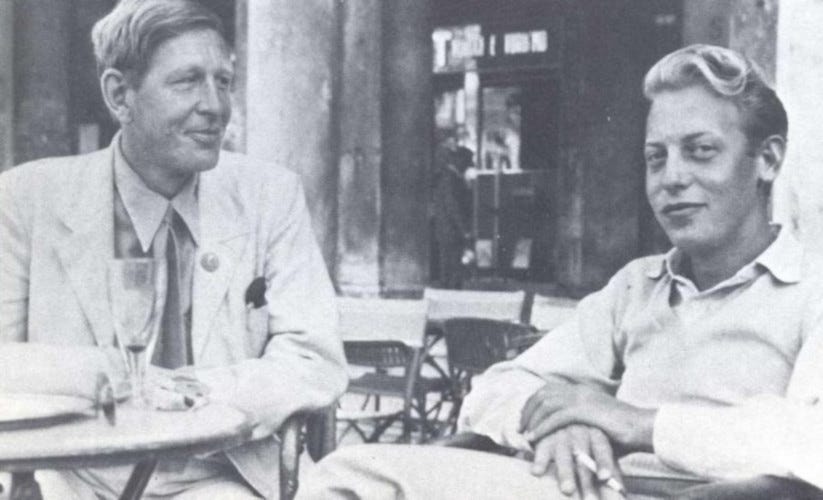
Ackroyd’s focuses on Auden the man rather than his genius as a poet, although he does not skip discussion of major poems and changes in his style. This is not an academic biography, but one that excels in depicting a gay man’s life and feelings. It is a sad book that reveals a genius poet who simply can’t cope with life and creates all kinds of (bad) mechanisms to protect himself.
The center of the biography (in addition to his poetry) is his long relationship with Chester Kallman. Despite lies, manipulations, betrayals and screaming fights, the relationship persisted giving both men something to hold on to. It’s no wonder Chester died in despair one year after Auden’s death (by dissolution and drink) in 1973 at the age of 66.
Auden by Peter Ackroyd is a vivid and moving depiction of one of the great poets of the 20th century, warts and all.
At the beginning of the new century, he is an indispensable poet. Even people who don't read poems often turn to poetry at moments when it matters, and Auden matters now.
New Yorker, 2002
…
Notes:
If you have never read Auden start with his shorter collected poems and then try some of his essays.
Comments
Post a Comment